September 8, 2026
Archbishop Lépine at the Assumption: “We Are Called to Carry Christ to the World”
September 8, 2026
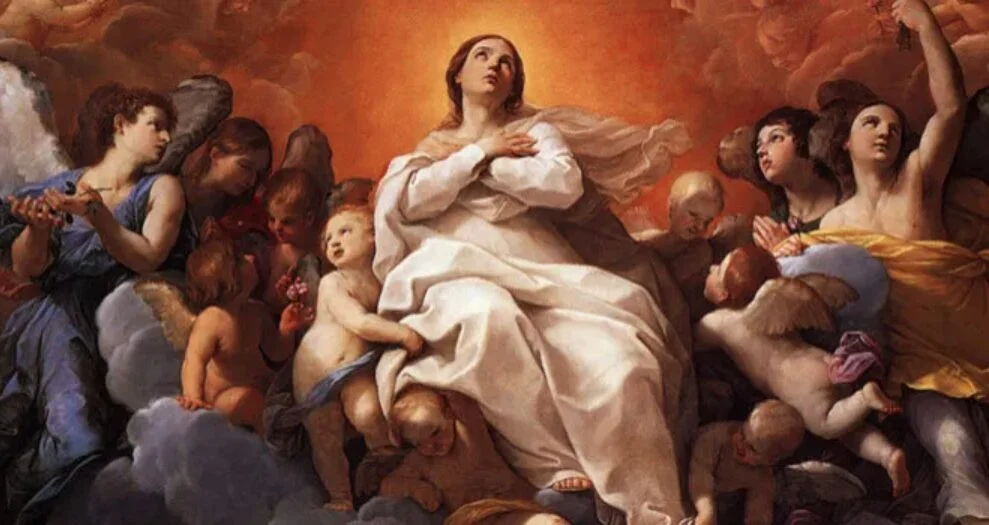
On the solemnity of the Assumption of the Blessed Virgin Mary, celebrated Saturday, Aug. 15, 2026, at Mary, Queen of the World Cathedral, Archbishop Christian Lépine of Montreal invited the faithful to contemplate Mary as mother, as a model of Christian life, and as an example for the mission of every baptized person.
In his homily, the archbishop recalled that devotion to Mary has accompanied Christians since the earliest centuries of the Church. At the foot of the Cross, when Jesus says to the disciple, “Here is your mother,” Mary is given to us as our mother. Her mission continues in heaven: she remains mother of the Church, and of each one of us.
A Mother Who Leads Us to Her Son
What is Mary’s greatest desire for us? To give us her Son, Jesus Christ.
Archbishop Lépine recalled that Christ is the one we need most deeply: he gives us life and opens the way to eternal life. Mary, in turn, always leads us toward her Son.
She is also a model for every baptized person. Her “yes” to God, “Here am I, the servant of the Lord; let it be with me according to your word,” reveals a heart that is faithful, ready, and full of hope.
“Mary’s heart is a school of availability to God,” the archbishop said, inviting each person to learn, after her example, to speak their own “yes” to the Lord.
Carrying Jesus to the World “With Haste”
This readiness also leads to mission. Archbishop Lépine spoke of Mary who, carrying Jesus within her, set out “with haste” to visit her cousin Elizabeth.
Following her example, every baptized person is called to carry Jesus Christ to the world, in daily life and wherever they may be. This mission is personal, but it also belongs to the whole Church.
The feast of the Assumption also reminds us of our hope: Mary, taken up body and soul into heaven, shares fully in the glory of Christ’s Resurrection. Her Assumption points to what we are all called to: eternal life with God.
Letting the Walls Fall
As Mass drew to a close, Archbishop Lépine invited the faithful to take part in a Jericho walk: seven times around the cathedral in prayer, recalling the Book of Joshua, where the Israelites circled the walls of Jericho seven times in faith and obedience, and the walls fell on their own, opening the city before them.
It was a symbolic gesture: an invitation to ask the Lord to bring down, the same way, whatever still stands between our hearts and the total “yes” Mary gave him.
The celebration concluded in keeping with the message of the homily: following Mary’s example, to open our hearts to God, to offer him our “yes,” and to carry Jesus Christ to the world with haste.
June 03, 2026
Pope Leo XIV Issues Encyclical on
Artificial Intelligence and Human Dignity
May 25, 2026
Signed on the 135th anniversary of Rerum Novarum, Pope Leo XIV’s first encyclical brings Catholic social teaching to bear on the age of artificial intelligence.
On May 25, Pope Leo XIV released Magnifica Humanitas (Latin: “Magnificent Humanity”), his first encyclical letter, on safeguarding the human person in the age of artificial intelligence. The document had been signed on May 15, the 135th anniversary of Rerum Novarum, Pope Leo XIII’s 1891 encyclical on the rights and dignity of workers, which laid the foundations of modern Catholic social teaching.
In Magnifica Humanitas, the Holy Father reflects on the sweeping transformations that the rapid rise of artificial intelligence has set in motion. Confronting what he calls a genuine “change of era,” the Pope affirms that human dignity must be the fixed criterion against which technological progress is measured and the decisions shaping our common future must be weighed.
The Dicastery for Promoting Integral Human Development, the Vatican body responsible for advancing Catholic social doctrine, describes Magnifica Humanitas as recognizing “a profound epochal shift” and as reading technological progress through the foundational principles of the Church’s social tradition: the common good, solidarity and subsidiarity. Against any culture of domination, power or exclusion, the encyclical calls for what the Pope names a “civilization of love,” grounded in justice, dialogue and shared responsibility.
Pope Leo XIV insists that the human being must not be displaced in a world being reshaped by automation, algorithmic systems and new forms of digital communication. Artificial intelligence, the encyclical acknowledges, holds genuine promise for human development; it must nonetheless remain, always, at the service of the person and of the dignity proper to every human being.
To accompany the encyclical, the Canadian Conference of Catholic Bishops (CCCB) has made available a collection of resources on the ethical, social and spiritual dimensions of artificial intelligence, including recent pontifical messages and reflection documents from the Holy See.
The faithful, and all who wish to engage these questions, are invited to read Magnifica Humanitas, a document Pope Leo XIV addresses to Catholics and to every person of goodwill alike, along with the accompanying resources available on the CCCB website:
April 3, 2026
Adoption of the Act to Reinforce Secularism in Quebec:
A Call for the Continuation of Respectful Dialogue and the Preservation of Fundamental Freedoms
Montreal, April 3, 2026
Following the adoption of the Act respecting the reinforcement of laicity in Québec (formerly Bill 9), the Archbishop of Montreal, Most Reverend Christian Lépine, acknowledges this decision while expressing serious concerns, particularly regarding the practice of prayer in public spaces.
The State plays an important and legitimate role in the organization of public life. That role, however, calls for maintaining a fair balance between the principles of secularism and the protection of fundamental rights and freedoms.
“We receive this decision with sincere consideration and respect, and with the conviction that it remains essential for us, as a society, to continue reflecting together on the place of religious expression in our shared public life, so that we may overcome prejudice and promote tolerance,” said Archbishop Lépine.
In this context, the Archbishop recalls that all religious faith and deeply held conviction — including atheism — is a matter of individual conscience and must be respected and protected. To restrict prayer to the private sphere is to reduce the space of freedom for society as a whole. The freedom to manifest one’s faith, alone or in community, in private and in public, is recognized by the Universal Declaration of Human Rights (1948, art. 18), the Quebec Charter of Human Rights and Freedoms (1976, art. 3), and the Canadian Charter of Rights and Freedoms (1982, art. 2a).
“The hallmark of a democratic society is its ability to welcome a plurality of convictions and allow their expression in a spirit of respect for all,” Archbishop Lépine said.
For many years, the Archdiocese of Montreal has maintained a harmonious relationship with municipal authorities and police services. This collaboration has always been grounded in a spirit of responsibility, adherence to shared rules, and commitment to public safety and the common good.
“We have always enjoyed cordial relations with municipalities, and we sincerely hope that this spirit of collaboration will continue in this new context,” he added.
The Archbishop also wishes to acknowledge the important role played by law enforcement in ensuring the safe and peaceful conduct of religious events. The Palm Sunday procession, held this past Saturday, brought together several thousand people in an atmosphere of peace and reverence.
“This gathering unfolded with calm and respect, thanks in great measure to an excellent collaboration with police, whom we warmly thank,” Archbishop Lépine said.
The Archdiocese of Montreal reaffirms its commitment to Quebec society, its respect for the rule of law, and its determination to pursue its mission while calling for constructive dialogue that fosters respectful coexistence among diverse religions and convictions.
Source : Archdiocese of Montreal
For further information :
Maribel Mayorga
Press Officer, Archbishop’s Office
Director, Communications and Media Relations
Telephone: 514-925-4300, ext. 207
Email: mmayorga@diocesemontreal.org